
Down-ballot drop-off isn't a sign of civic laziness. It's an entirely rational response to an underperforming and irrational civic system.
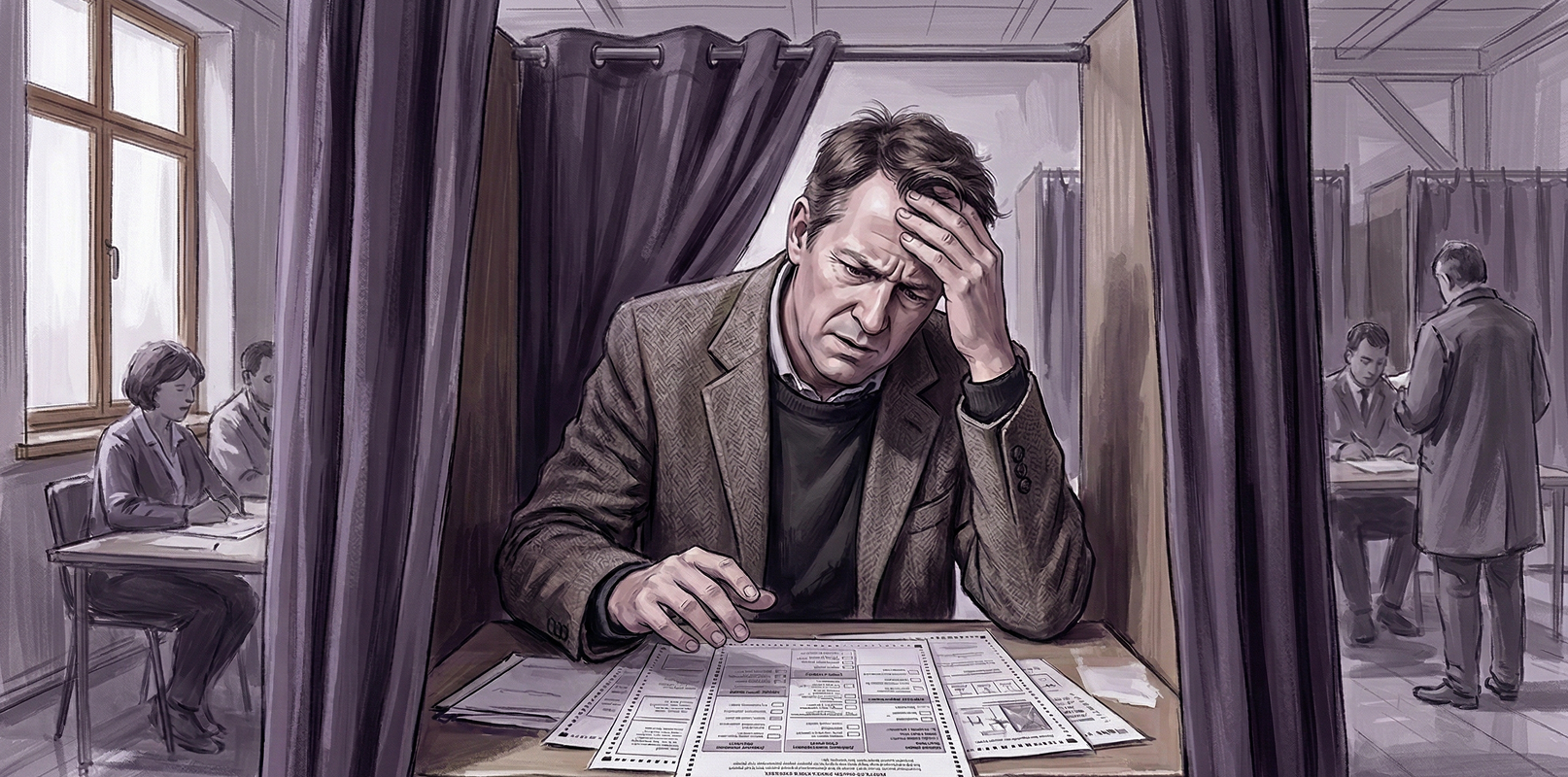
It happens in the booth, usually somewhere between the school board race and the water district commissioner. You stare at two names you've never heard of, for a job you couldn't fully explain, with no idea what either person actually stands for. So you do what millions of Americans do every election cycle: you skip it. You leave it blank. You move on.
And then, somewhere between folding your ballot and walking back out into the daylight, a quiet, uncomfortable thought settles in.
Should I have known that?
The answer is no. But not for the reason you might expect.
Political scientists call it "ballot roll-off" — the measurable drop in votes cast as you move from the top of a ballot to the bottom. By the time you reach judges, ballot amendments, local commissioners, and school board seats, participation can fall by 20, 30, even 40 percent compared to the top of the ticket. [1]
That's not a rounding error. In many states, those down-ballot offices control more of your daily life than the presidential race that consumed two years of national attention — your property tax rate, your child's school curriculum, the zoning laws that shape your neighborhood, and the judges who interpret state law.
And yet we've spent decades treating this as a character flaw. We call it apathy. We run campaigns urging citizens to "do their civic duty" as though the problem is motivation - not the product of an underperforming system.
The resources that citizens rely on at the ballot box were built for a different era — one of far smaller districts, slower-moving information, and governance that touched fewer corners of daily life. Our system hasn’t been updated to match the needs of today’s citizens.
Consider ballot amendments. The official language is written for legal precision, not public comprehension. Studies have found that the average ballot amendment is written at a 17th-grade reading level — three years beyond a college degree. [2] Unfortunately, ballot language evolved to satisfy legal review, not the citizen standing in the booth.
Or consider judicial elections. Citizens are asked to evaluate candidates for positions requiring deep legal expertise, using ballots that offer almost nothing beyond a name. In many states, judicial candidates are legally prohibited from expressing views on the very issues their courts will decide. [3] The information ceiling isn't anyone's deliberate design — it's the accumulated result of a legal culture and an election system not developed with one another in mind.
The same gap appears in local races. A candidate for city comptroller or county assessor may have no meaningful press coverage, no digital presence, and a campaign budget of a few thousand dollars, while the office they're seeking shapes policy affecting hundreds of thousands of people. Citizens are expected to arrive informed — without adequate tools to understand.
Think about the last time you made a significant purchase. You probably didn't arrive having memorized the technical specifications. You used tools: comparison sites, plain-language summaries, review aggregators that translated complexity into something you could actually act on. That infrastructure exists because there was a market incentive to build it.
Civic participation hasn’t gotten the same attention. In the absence of neutral, citizen-aligned tools, the gap gets filled with whatever information sources do exist — and those are rarely designed around the citizen's needs. [4]
That is the gap that SureVoter is working to close.
The premise is simple: the experience of voting should be at least as comprehensible as the experience of buying a refrigerator. Not dumbed down — clarified. There is a meaningful difference. A well-designed civic tool doesn't tell you what to think. It gives you the context to think for yourself.
You were never supposed to walk out of that booth in quiet discomfort. You were supposed to walk out with a sense of satisfaction — having participated, fully and confidently, with the sense that your choices were thoughtful and reflected your values.
The gap between that experience and the one millions of Americans have right now is not a gap in civic virtue. It is a gap in infrastructure.
We have built seamless, intuitive tools for nearly every other consequential decision in modern life. The Republic deserves the same thoughtfulness applied to its most fundamental act.
That blank line at the bottom of your ballot isn't your failure. It's an unfinished assignment — and it belongs to all of us.
SureVoter is building civic infrastructure to make democracy easier, for everyone. We're sharing our journey openly as we build. Follow along at SureVoter.com.
[1] Darcy, R., & Schneider, A. (1989). Confusing Ballots, Roll-Off, and the Black Vote. Western Political Quarterly. Research has consistently documented roll-off rates of 20–40% between the top of the ticket and down-ballot races in general elections.
[2] Kimball, D. C., & Kropf, M. (2005). Ballot Design and Unrecorded Votes on Paper Ballots. Public Opinion Quarterly. See also: National Conference of State Legislatures. (2022). Ballot Language Readability Studies, which found average ballot amendment language written above a post-graduate reading level in the majority of states surveyed.
[3] Bonneau, C. W., & Hall, M. G. (2009). In Defense of Judicial Elections. Routledge. The Canon of Judicial Conduct in most states prohibits judicial candidates from making pledges or promises about how they would rule — creating an inherent information ceiling for citizens in judicial races.
[4] Wesleyan Media Project. (2023). Political Advertising in the United States: Targeting, Spending, and Reach. Documents the sophisticated micro-targeting infrastructure deployed by campaigns and interest groups in contrast to the information tools available to the average citizen.