
We've thought carefully about the ways this could fail. We think talking about them openly is part of how we prevent them.
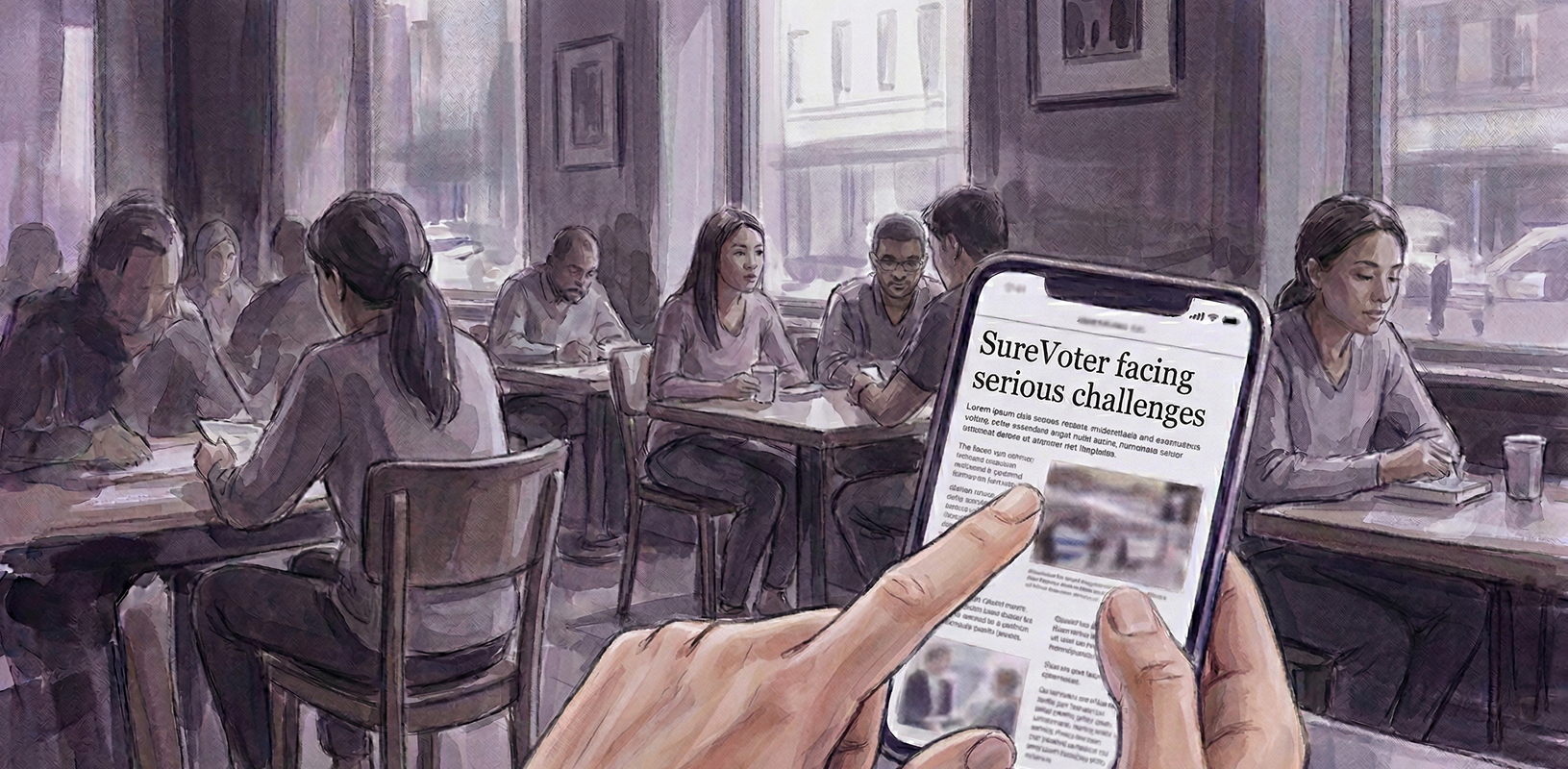
Most companies write about their work from a posture of confidence bordering on inevitability. We are going to do the opposite.
This post catalogs the specific ways we believe SureVoter could go wrong — not as a theoretical exercise, but as a practical commitment to the intellectual honesty this mission requires. If we are asking citizens to trust us with civic infrastructure, the least we can do is show them we have stared clearly at our own failure modes.
There are seven we worry about most.
The tools SureVoter builds will involve algorithms that produce structured outputs — ballot summaries, representative comparisons, constituent signal analyses. Algorithms encode the assumptions of the people who build them. A summary tool trained on urban media markets may produce subtly different outputs for rural ballot measures. A representative profile system relying on digital records will disadvantage representatives with less digital footprint — which often correlates with serving smaller, less resourced communities. A constituent signal tool that weights by engagement patterns may systematically under-represent older citizens who engage with civic technology differently than younger ones. None of these biases would be intentional. All of them could distort the information environment in ways that are difficult to detect without specifically looking. [1]
We are committing to regular, independent algorithmic audits — conducted by researchers not on our payroll who will publish their findings publicly. We are building diverse teams because homogeneous teams build tools with homogeneous blind spots. And we are designing the platform to make its methodology transparent and legible to external researchers.
SureVoter is designed to amplify the signal of ordinary citizens over coordinated noise. But organized actors who understand how our tools work will attempt to game them. If our constituent signal tools respond to volume, well-resourced organizations will generate volume. If our representative profile system relies on self-reported information, campaigns will optimize their self-reporting. If our ballot summary methodology favors certain source types, organizations will learn to produce content those sources cite. This is the predictable behavior of any organized interest that perceives a change in the information environment as a threat to its current advantages — and it has played out across every civic information platform that has attempted to provide neutral signal. [2]
We are designing manipulation-resistance into the architecture from the beginning — weighted verification systems, transparent sourcing requirements, and ongoing red-team exercises in which we actively attempt to manipulate our own tools. We will not win every round. We will lose some, learn, and adapt publicly.
A platform that changes the civic information environment may, if it succeeds, attract scrutiny from actors whose interests that change affects — including, in some cases, actors in positions of regulatory authority. Civic technology platforms in various democratic contexts have faced regulatory challenges and legislative pressure when they altered the conditions under which political decisions get made. [3] In the United States, a platform perceived as threatening to a governing majority — at the federal or state level — could face hostile regulatory attention or legislative attempts to impose requirements that compromise its independence.
Our dual structure — private operating company plus independent nonprofit Foundation — provides meaningful protection, as does our radical nonpartisanship. A platform that demonstrably serves citizens across the full civic spectrum is a harder target for politically motivated pressure than one that can be credibly characterized as ideologically aligned. We are investing in legal resources specifically designed to defend the platform's independence, and building relationships across the broad coalition of civic organizations that share an interest in citizen-aligned information infrastructure.
Nonprofit organizations can drift toward the ideological preferences of their major donors over time — not through corruption, but through the entirely natural dynamics of any organization that depends on continued funder approval. The SureVoter Foundation is designed to steward the platform's civic integrity permanently. But the Foundation itself must be funded, and those funding sources, if not carefully designed, could introduce precisely the distortions the Foundation is meant to prevent. [4]
We are designing the Foundation's funding model around diversification requirements — structural limits on the percentage of funding that can come from any single donor or category of donor — and exploring a sustainable revenue base derived from the platform's commercial operations to reduce philanthropic dependence over time. We do not yet have a complete answer. We are naming it as an open problem because it is one.
There is a version of SureVoter's success we actively do not want: one in which the platform becomes so dominant in the civic information space that it creates a new single point of failure — or control. A technical failure during a high-stakes election could deprive citizens of information at a critical moment. A successful data breach could expose sensitive civic engagement data. A subtle methodological error — made in good faith — could influence outcomes in ways that are never fully visible. We are, in short, worried about becoming too important. [5]
We are designing the platform's architecture with interoperability and openness as explicit goals — making it possible for other civic information tools to coexist with SureVoter rather than be displaced by it. We are committing to open-sourcing significant portions of our methodology so independent researchers and alternative platforms can build on and verify our work. A civic information ecosystem is healthier with multiple trusted actors than with a single dominant one — even one with the best intentions.
Companies that begin with clear civic missions can lose them — not through dramatic betrayal, but through the accumulation of small compromises, each individually defensible, that together redirect the organization's center of gravity from mission to commercial survival. The pressure points are predictable: a fundraising shortfall that makes a large donation from an ideologically interested donor hard to refuse; a product decision that would increase engagement but subtly reward partisan content; a partnership that offers distribution in exchange for influence. [6]
The Foundation's structural authority over the operating company is specifically designed to create a binding constraint on mission drift — one that cannot be overridden by a board under commercial pressure. We are also committing to an annual mission integrity report: an honest public accounting of the commercial pressures we faced in the previous year, how we responded, and whether we believe our responses were consistent with our founding mission. Accountability by design, not by aspiration.
The most humbling risk is the simplest: we might be building the wrong thing. Our diagnosis — civic information gaps, legislative data fog, distorted constituent signal — is based on extensive research and expert input. But we are not citizens in every community we are trying to serve. We are not state representatives in under-resourced offices navigating a hostile information environment. The tools we design based on our current understanding may not be the tools those people actually need. [7]
We are building a sustained civic listening program — ongoing, structured engagement with the citizens, officials, and election administrators whose experiences must shape our design decisions. We are treating this as a core product development function, not a marketing activity. And we are committing to publishing what we learn — including the ways our original assumptions have been wrong. The willingness to be corrected by evidence is among the most important capabilities a civic technology organization can have.
We don't think we have a choice — not if we want to be the kind of organization we are claiming to be. Institutional trust is not lost all at once. It erodes through the accumulation of risks minimized when they should have been named, and problems discovered late because no one was looking for them.
We are asking citizens to trust us with something important. The minimum we can offer in return is honesty about what could go wrong, and transparency about how seriously we are working to prevent it. We don't expect to get everything right. We expect to learn, adapt, and remain accountable to the mission — in public, over time.
That is the commitment.
SureVoter builds with transparency because we believe trust is earned through honesty, not assurances. Follow our build at SureVoter.com.
[1] O'Neil, C. (2016). Weapons of Math Destruction: How Big Data Increases Inequality and Threatens Democracy. Crown. O'Neil's analysis of algorithmic bias across civic and commercial domains provides the foundational framework for understanding how well-intentioned automated systems can produce systematically discriminatory outputs — particularly when training data reflects existing social inequalities.
[2] Wardle, C., & Derakhshan, H. (2017). Information Disorder: Toward an Interdisciplinary Framework for Research and Policy Making. Council of Europe. Documents the systematic strategies through which organized actors exploit information platforms — including fact-checking services, aggregators, and civic information tools — through coordinated inauthentic behavior designed to produce artificially amplified signals.
[3] Freedom House. (2023). Freedom on the Net: The Repressive Power of Artificial Intelligence. See also: Deibert, R. (2020). Reset: Reclaiming the Internet for Civil Society. House of Anansi Press. While the most acute examples of civic technology suppression occur in authoritarian contexts, the report documents pressure on civic information platforms in democratic systems including selective regulatory enforcement and legislative threats.
[4] Callahan, D. (2017). The Givers: Wealth, Power, and Philanthropy in a New Gilded Age. Knopf. Callahan's analysis finds that even foundations with explicit commitments to nonpartisanship have drifted toward the ideological preferences of major donors over multi-decade periods.
[5] Zittrain, J. (2008). The Future of the Internet — And How to Stop It. Yale University Press. Zittrain's framework for thinking about centralization risks in information infrastructure — the danger that dominant platforms create dependency that ultimately undermines the resilience and diversity of the systems they replace — is directly applicable to civic information platforms.
[6] Stacy Mitchell & Olivia LaVecchia. (2016). Amazon's Stranglehold: How the Company's Tightening Grip Is Stifling Competition, Eroding Jobs, and Threatening Communities. Institute for Local Self-Reliance. Cited here for its framework of how mission drift occurs through commercial scaling — a dynamic that applies across sectors including civic technology.
[7] Costanza-Chock, S. (2020). Design Justice: Community-Led Practices to Build the Worlds We Need. MIT Press. Costanza-Chock's framework for participatory design — the principle that the people most affected by a technology must be central to its design, not merely consulted after the fact — directly informs our approach to civic technology development.